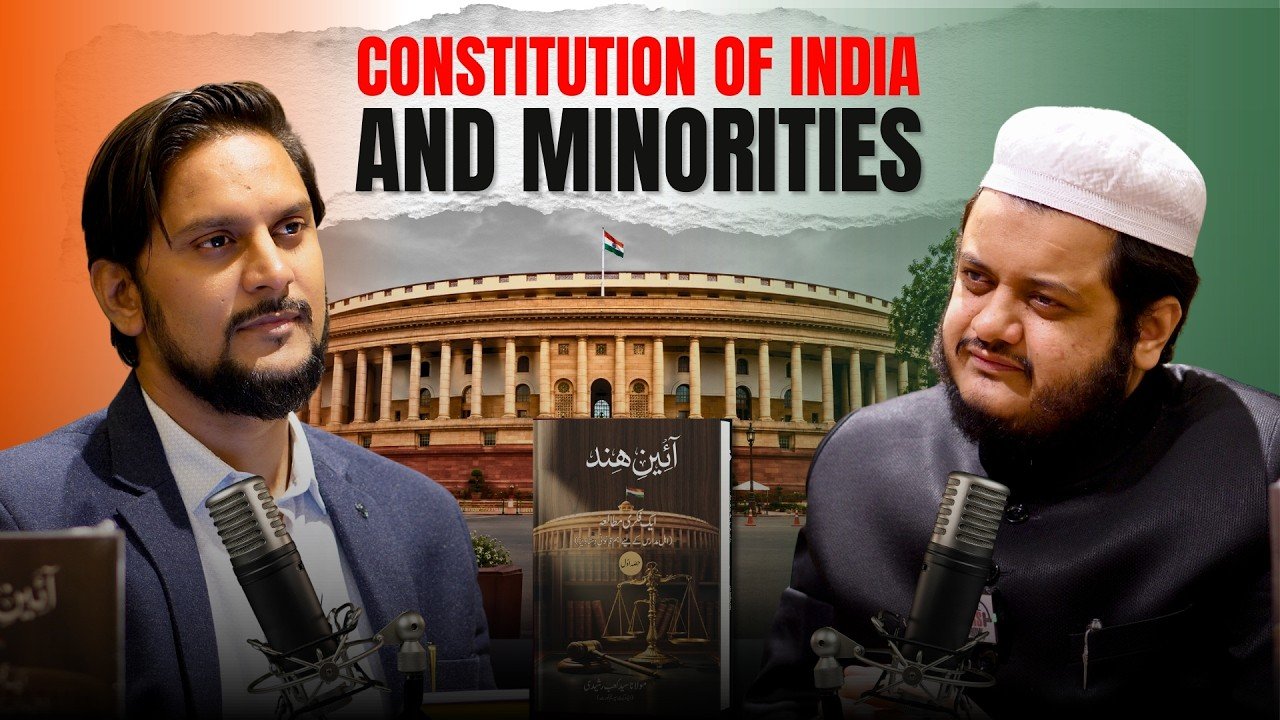
What happens when a young person decides to enter a profession that his own community rarely encourages?
For Syed Kaab Rasheedi, the answer was to study law, understand the Indian Constitution and use that knowledge to serve his community and society.
On this episode of The HRS Show, Syed Kaab Rasheedi shares the journey that took him from a traditional Islamic educational background to studying law and eventually becoming an advocate at the Supreme Court of India.
The conversation goes beyond his personal career.
It explores why young people need to understand their rights and duties, why law can be a powerful career, why communities need more legal professionals and how his book Aaene Hind aims to make constitutional and legal information more accessible.
Watch the Full Conversation
Hear Syed Kaab Rasheedi discuss his journey, law, constitutional rights, youth education and Aaene Hind in his own words on The HRS Show.
Click the image below to watch the full episode on YouTube.
1. Growing Up in an Islamic Scholarly Family
Syed Kaab Rasheedi was born into a family with a long scholarly tradition.
He describes his family as an ilmi khandan—a family deeply connected with Islamic scholarship and education. He speaks about his great-grandfather, grandfather and father, and the educational institutions and religious work associated with his family.
Religious education therefore became a natural part of his childhood.
He memorized the Qur’an and completed his Hifz at the age of 13.
But his education did not stop there.
One of the more interesting parts of his story is how his mother encouraged him to pursue modern education after he completed Hifz.
He went on to complete his school education and graduation while continuing his religious studies.
This combination eventually became important in shaping his outlook.
2. Why His Time Abroad Changed His Perspective
Another turning point came when Rasheedi travelled to Johannesburg for a language course.
He describes studying alongside people from different countries and backgrounds. Being exposed to different cultures and viewpoints made him reconsider the idea that one person’s perspective is automatically superior.
Instead, he learned the value of listening to different viewpoints and appreciating the good work being done by people in different fields.
The experience, he explains, helped him become more flexible in his thinking and more open to different perspectives.
That lesson became important later in his professional journey.
3. Why Did Syed Kaab Rasheedi Choose Law?
After completing his education, Rasheedi decided that he wanted to study law.
His father did not simply tell him whether the decision was right or wrong. Instead, he asked him why he wanted to pursue law.
Rasheedi’s answer was connected to service.
He wanted to understand the Constitution, rights and duties and eventually use that knowledge to contribute to his community.
He went on to study law at Lucknow University.
Even before completing his law education, he began focusing heavily on constitutional issues, rights and duties.
Eventually, after the COVID period and during the final stage of his legal education, he was appointed as a legal adviser to Jamiat Ulama Uttar Pradesh.
His career had taken a direction that combined his educational background with his interest in law and constitutional matters.
4. Why Are Young People Not Choosing Law?
One of the central questions in the conversation is why law does not receive enough attention in career counselling.
Rasheedi argues that young people should look more seriously at the legal profession.
He describes law as a profession with significant scope and responsibility, particularly for those who want to work in the High Courts or Supreme Court.
But for him, the value of law goes beyond money.
A lawyer can understand the Constitution, represent people in court and help individuals understand their legal rights.
That is particularly important when people do not know where to turn when they face a legal problem.
5. Understanding Your Constitutional Rights
A major theme throughout the episode is constitutional awareness.
Rasheedi argues that many ordinary citizens do not have a strong understanding of their basic rights.
He believes that knowing your rights gives you the confidence to stand up for them.
The conversation also discusses the relationship between rights and responsibilities.
The Constitution does not simply provide citizens with rights. It also includes fundamental duties.
The larger message is straightforward:
Citizens should understand both what they are entitled to and what responsibilities they carry.
This awareness can help people participate more responsibly in society.
6. The Constitution and Its “Basic Structure”
The discussion also touches on the landmark Kesavananda Bharati v. Union of India case.
Rasheedi highlights the importance of the Supreme Court’s decision and the principle that the Constitution has a basic structure that cannot simply be destroyed through amendments.
The episode uses this discussion to emphasize why constitutional literacy matters.
If people do not understand the Constitution, it becomes difficult for them to understand the principles that protect their rights.
Rasheedi describes fundamental rights as being at the heart of the Constitution.
For young people in particular, learning these fundamentals can provide a stronger understanding of citizenship.
7. Aaene Hind: Making Legal Information Accessible
This brings us to the book at the centre of the episode: Aaene Hind.
Rasheedi explains that the book was created to address a practical problem.
Many people may need legal information but do not know how to access or understand it.
The book attempts to make important constitutional and legal material more accessible, including information relating to institutions, laws and legal procedures.
He explains that the book includes legal documents and orders, including English versions, so that readers can understand the material and use it when approaching government officials or authorities.
The intention is not simply to provide information.
It is to provide guidance that people can actually use.
8. Why the Book Is Not Only for One Community
Although the conversation frequently discusses issues affecting Muslims and Islamic institutions, the purpose of Aaene Hind is presented in a broader context.
Rasheedi explains that the book is intended for people studying in madrasas, colleges, working professionals and young people who want to bring positive change to society.
The book is therefore connected to a larger idea:
Legal awareness should not remain limited to lawyers.
Ordinary citizens should have enough basic knowledge to understand the system they live in.
9. Preparing the Next Generation
Another strong theme in the conversation is the need to give young people responsibility.
Rasheedi argues that older generations sometimes hold onto responsibilities for too long instead of preparing younger people to take over.
His message is that communities need to develop the next generation rather than continually treating young adults as children.
He gives examples from Islamic history where younger people were given responsibility and opportunities to lead.
For him, developing young people means giving them space to learn, make decisions and contribute.
10. Find Your Goal Before Choosing Your Path
Towards the end of the conversation, Rasheedi gives advice to young people who want to create change but don’t know what direction to take.
His answer is simple:
First, decide where you want to go.
He uses the example of travelling to Delhi. If you don’t know your destination, you can travel for a long time without actually getting closer to where you want to be.
The same principle applies to careers and personal goals.
Before choosing a course, profession or career path, young people should ask themselves:
- What do I want to achieve?
- Why do I want to achieve it?
- What skills will I need?
- Who can guide me?
- How can my career benefit other people?
A clear destination makes it easier to choose the right route.
Final Thoughts
Syed Kaab Rasheedi’s journey is a story about education, career choices and responsibility.
He grew up in a traditional scholarly environment, pursued modern education, studied law and eventually began using his legal knowledge to work on issues involving constitutional rights and community concerns.
His message to young people is particularly relevant.
Don’t limit yourself to the careers that everyone around you is choosing.
Learn.
Explore different fields.
Understand the Constitution.
Know your rights and responsibilities.
And most importantly, find a purpose behind your education and career.
His book Aaene Hind is an extension of that mission: making legal and constitutional information more accessible so that people can become more informed about the system around them.
The broader lesson from the conversation is that education becomes most valuable when it enables people to understand their responsibilities, stand up for their rights and contribute positively to society.
The future depends not only on what today’s generation achieves, but on how well it prepares the generation that follows.
The HRS Show also explores stories of discipline, purpose and personal growth. Read our conversation with Motesham Ali Khan to learn how years of discipline and commitment shaped his journey.
“Read our conversation with Motesham Ali Khan”

Subscribe to The HRS Show for more conversations on mindset, discipline, and purpose. [Watch on YouTube →]
