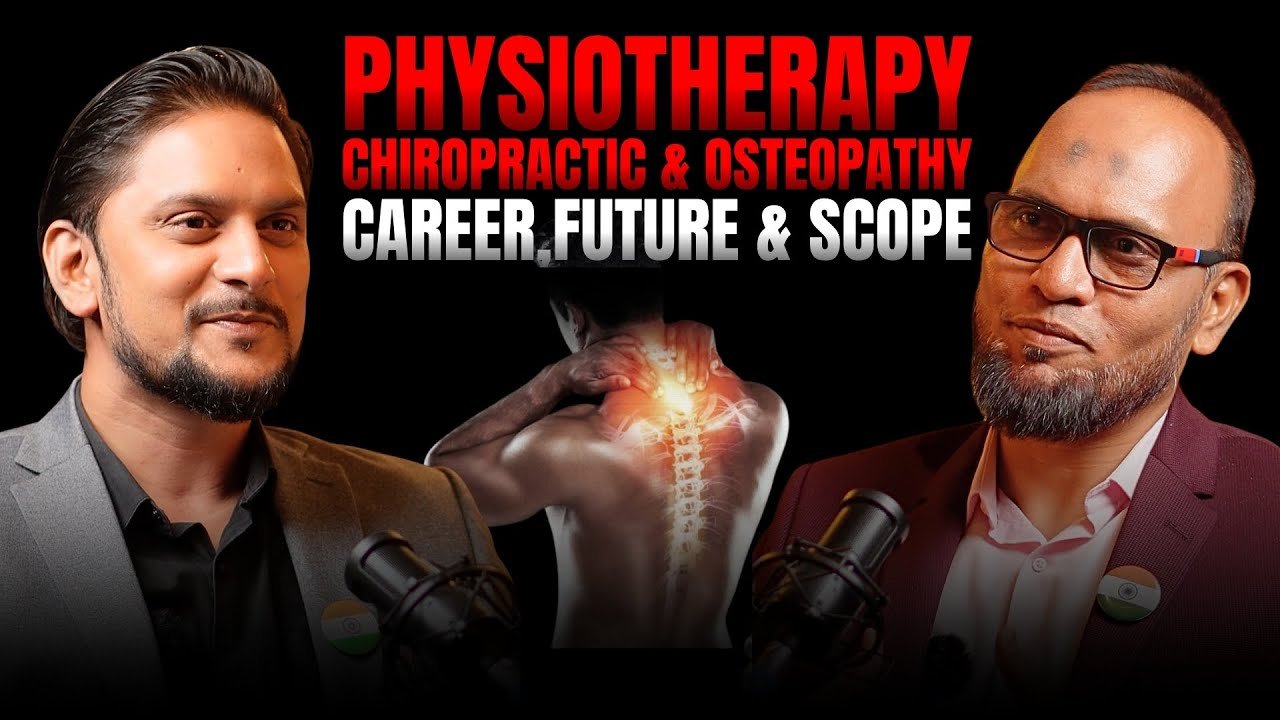
Pain is something most people experience at some point in their lives.
Back pain, neck pain, shoulder pain, headaches and joint pain are often treated as inconveniences that should simply be suppressed with medication.
But what if pain is actually trying to tell us something?
In this episode of The HRS Show, host Habib speaks with Dr. Abdul Hakeem, an experienced physiotherapist and practitioner who has trained in physiotherapy, chiropractic and osteopathic practices. The conversation explores pain, posture, exercise, stress, preventive health and the differences between physiotherapy, chiropractic care and osteopathy.
One of the strongest messages from the discussion is simple:
Don’t wait for your body to break down before you start taking care of it.
Watch the Full Conversation
click the thumbnail to watch the full episode on YouTube
Who Is Dr. Abdul Hakeem?
Dr. Abdul Hakeem’s journey into physiotherapy was not straightforward.
He grew up with a rural, Kannada-medium education and initially considered entering the transportation business after completing his PUC.
His parents, however, encouraged him towards a professional education. He initially considered nursing before being guided towards physiotherapy by an educationist who recognized his potential.
At the time, physiotherapy was not widely understood by the public.
That decision eventually developed into a long professional journey involving physiotherapy, chiropractic and osteopathic training. According to the interview introduction, Dr. Hakeem completed his bachelor’s and master’s education in physiotherapy, pursued further training in chiropractic from Sweden and osteopathic manipulative practices from Japan, and has participated as a resource person and speaker at professional workshops and conferences.
Why Understanding Pain Matters
One of the most important points raised during the conversation is that pain should not automatically be viewed as the enemy.
Pain can be a signal.
When something hurts, the body may be communicating that something needs attention.
That doesn’t mean every pain represents a serious condition. But it does mean that repeatedly suppressing symptoms without understanding their cause may not address the underlying issue.
The interview encourages people experiencing persistent or unexplained pain to seek appropriate professional evaluation rather than relying entirely on advice from friends, family or over-the-counter medication.
Don’t Always Ignore Back Pain, Neck Pain or Headaches
Back pain and neck pain are extremely common, particularly among people whose daily routines involve prolonged sitting, repetitive movements or poor posture.
Headaches can also have different causes.
The interview discusses the possibility that some headaches diagnosed as migraine may actually be associated with problems involving the cervical region, describing these as cervicogenic headaches.
This is why proper assessment matters.
Rather than assuming that every headache is the same, the underlying cause needs to be considered.
Important: The claims discussed in the episode are the guest’s clinical perspective and should not be treated as a diagnosis for an individual. Persistent, severe or unusual pain should be evaluated by an appropriately qualified healthcare professional.
Physiotherapy vs Chiropractic vs Osteopathy
One of the most interesting parts of the conversation is the attempt to explain the difference between three approaches that are often confused.
According to Dr. Hakeem’s explanation in the interview:
Physiotherapy
Physiotherapy is described as focusing more directly on the area where the patient is experiencing the problem, using assessment, exercise and therapeutic modalities.
For example, someone presenting with shoulder pain may receive local assessment and treatment.
Osteopathy
The interview describes osteopathy as taking a broader or global approach, looking beyond the immediate location of pain and considering possible relationships elsewhere in the body.
Chiropractic
Chiropractic, as explained by Dr. Hakeem, places particular emphasis on the spine and its relationship with the nervous system.
The three approaches therefore have different schools of thought and perspectives.
The guest’s own practice combines them as an integrated approach, rather than treating them as completely isolated systems.
Why an Integrated Approach Can Be Useful
Dr. Hakeem explains that combining different approaches allows practitioners to adapt treatment according to the individual patient.
For example, he describes how an older patient may not be an appropriate candidate for certain chiropractic adjustments because of the fragility associated with advanced age.
In such circumstances, he describes using a gentler osteopathic approach.
For other patients, physiotherapy modalities may be appropriate.
The central idea is that treatment should be adapted to the individual, rather than forcing every patient into exactly the same method.
Exercise Is Not the Same as Everyday Physical Activity
This was one of the most useful distinctions in the interview.
Many people say:
“I don’t need exercise. I am active all day.”
Someone may spend the entire day cleaning, climbing stairs, working, walking around a workplace or performing physically demanding tasks.
But Dr. Hakeem distinguishes this everyday exertion from deliberately setting aside time for exercise.
The idea is that exercise is intentional.
You make time specifically to improve your physical and mental condition.
That difference matters because simply being tired at the end of the day does not necessarily mean that you have followed a balanced fitness routine.
Why Posture Matters
Posture is another major theme throughout the conversation.
Whether sitting, standing, lying down or working, the body is constantly dealing with gravity.
Poor positioning maintained for long periods can place unnecessary stress on muscles and joints.
This becomes particularly relevant for people working at computers.
IT professionals and office workers may spend many hours in the same position, often without realizing how much time has passed.
A healthy routine therefore shouldn’t begin only when pain appears.
Posture awareness should be part of prevention.
The Modern Problem: Sitting for Too Long
Modern work has changed the way people use their bodies.
Many people now spend hours:
- Sitting at desks
- Looking at screens
- Using smartphones
- Driving
- Working remotely
- Remaining in the same position
The body, however, was not designed to remain completely still for most of the day.
Regular movement can therefore become an important part of maintaining physical health.
The message from the interview is not that everyone needs an extreme workout.
It is that movement should not disappear from your daily routine.
Stress Can Affect the Body Too
The conversation also explores the connection between mental stress and physical health.
Stress isn’t simply something that happens “in the mind.”
It can influence the way a person carries their body, moves and responds physically.
The discussion connects stress with posture and the body’s physiological responses and emphasizes the importance of maintaining both physical and mental wellbeing.
This is one reason exercise can be valuable beyond physical strength.
A deliberate period of walking, swimming, gym training or another activity can provide time away from the constant demands of work and screens.
Why Preventive Health Matters
One of the strongest recommendations in the episode is to stop thinking about health only after something goes wrong.
Instead of waiting for significant pain, people can pay attention to:
- Nutrition
- Posture
- Physical activity
- Rest
- Stress management
- Regular health checks
- Overall lifestyle
The principle is similar to maintaining a vehicle.
You don’t wait for your car to completely stop working before servicing it.
Your body deserves the same attention.
Take Care of Yourself Before Taking Care of Everything Else
Dr. Hakeem shares a memorable line based on a couplet attributed to Mirza Ghalib:
“Attend yourself before attending surroundings.”
The idea is simple.
People often spend enormous amounts of energy looking after:
- Their families
- Their jobs
- Their businesses
- Their homes
- Their finances
- Their responsibilities
while neglecting themselves.
But if your own health deteriorates, eventually those responsibilities become harder to manage.
Taking care of yourself is therefore not necessarily selfish.
It can be part of being able to take care of others.
The “Sharpen the Axe” Principle
The interview uses the familiar idea of sharpening an axe before cutting wood.
If someone spends all their time working but never takes time to maintain themselves, their productivity can eventually suffer.
The same principle can be applied to health.
Work harder isn’t always the answer.
Sometimes you need to stop, recover, exercise and prepare yourself so that you can perform better afterwards.
Why Women Shouldn’t Neglect Exercise
The conversation specifically addresses women and the tendency for many women to consider household work sufficient physical activity.
Someone may spend the entire day cooking, cleaning, climbing stairs and taking care of family responsibilities.
But that doesn’t necessarily replace deliberate exercise.
The purpose of a morning walk or workout is different.
It is an intentional investment in physical and mental wellbeing.
The interview encourages women to make time for themselves rather than assuming that household responsibilities automatically provide everything their bodies need.
Physiotherapy as a Career for Women
The discussion also addresses whether physiotherapy is a suitable career for women, particularly because the profession can involve physical contact with patients.
Dr. Hakeem explains that female physiotherapists represent a significant part of the profession and describes how his own centre maintains separate male and female sections, with female patients being attended to by female physiotherapists.
He also points out that modern physiotherapy includes many modalities and approaches that don’t necessarily require the same level of physical contact.
This makes physiotherapy a potentially broad career path for students interested in healthcare and rehabilitation.
The Importance of Continuing to Learn
Another major theme from Dr. Hakeem’s career story is continuous learning.
His professional journey didn’t stop after completing one qualification.
He continued pursuing additional training and exposure to different schools of thought.
His message to students and professionals is that learning should be a never-ending process.
Once someone stops learning, they risk falling behind people who continue developing their knowledge and skills.
For healthcare professionals in particular, continuing education can be an important part of professional development.
His Advice to Students: Seven Qualities for Success
Towards the end of the conversation, Dr. Hakeem gives students a broader message that goes beyond physiotherapy.
1. Intention
Have a clear intention about where you want to go.
He encourages students to aim for excellence rather than being satisfied with mediocrity.
2. Good Company
Your environment matters.
The people around you can influence your habits, thinking and ambitions.
3. Hard Work
Success requires disciplined use of time.
Hard work isn’t simply being busy.
It involves using your time purposefully.
4. Passion
Hard work combined with genuine passion can help someone develop expertise in their field.
5. Patience
Success rarely happens overnight.
Sabr — patience — is necessary.
6. Sacrifice
Every worthwhile goal requires some form of sacrifice.
Students may need to sacrifice comfort, entertainment or free time while building their careers.
7. Gratitude
The discussion also emphasizes shukr — gratitude — alongside patience.
These qualities together provide a framework for navigating both success and difficulty.
A Simple Fitness Routine: Start Moving
When asked about fitness, Dr. Hakeem describes spending significant time on his own physical routine, including walking and gym training.
But the broader lesson isn’t that everyone needs to copy his exact routine.
Instead:
Find an activity you can consistently maintain.
That could be:
- Walking
- Swimming
- Gym training
- Sports
- Mobility exercises
- Another suitable physical activity
Consistency matters more than creating an unrealistic routine that you abandon after a week.
Your Body Is Worth Maintaining
Perhaps the most memorable analogy from the episode is the comparison between the human body and a vehicle.
People maintain their cars.
They clean them.
They check the engine.
They replace worn parts.
They service them regularly.
People maintain their homes and gadgets too.
But how often do we deliberately ask:
“Am I actually taking care of my body?”
The interview describes the human body as a highly complex system containing hundreds of joints, hundreds of muscles and connective tissue structures.
Whether or not you follow every anatomical figure mentioned in the conversation, the underlying message remains valuable:
Your body requires maintenance.
Don’t Wait Until You’re in Pain
The easiest time to start caring for your health is before something goes wrong.
Build movement into your routine.
Pay attention to your posture.
Don’t ignore persistent pain.
Don’t automatically self-medicate.
Get appropriate professional advice when necessary.
Give yourself time to recover.
And remember that physical health and mental wellbeing are connected.
Final Thoughts
The conversation with Dr. Abdul Hakeem goes far beyond physiotherapy.
It asks a much broader question:
Are we actually taking care of the bodies that carry us through life?
Modern work has made many people sedentary.
Technology has reduced movement.
Stress has increased.
People often ignore minor discomfort until it becomes significant.
And when pain finally arrives, the first instinct is often to suppress it rather than understand it.
The better approach is prevention.
Move regularly.
Maintain good habits.
Pay attention to posture.
Take care of your mental health.
Seek appropriate professional evaluation when something doesn’t feel right.
And most importantly, don’t wait until your body forces you to pay attention.
Take care of yourself before taking care of everything around you
Watch the Full Episode
For the complete discussion on physiotherapy, chiropractic care, osteopathy, pain, posture, exercise, stress and preventive health, watch the full conversation with Dr. Abdul Hakeem on The HRS Show.
Watch the full episode on YouTube:
The HRS Show also explores meaningful conversations on faith, family and personal wellbeing. Read our discussion on Deen & Dunya: Building a Strong Muslim Life to discover valuable insights on raising children, choosing good company, strengthening families and living with purpose.
Subscribe to The HRS Show for more conversations on mindset, discipline, and purpose. [Watch on YouTube →]
