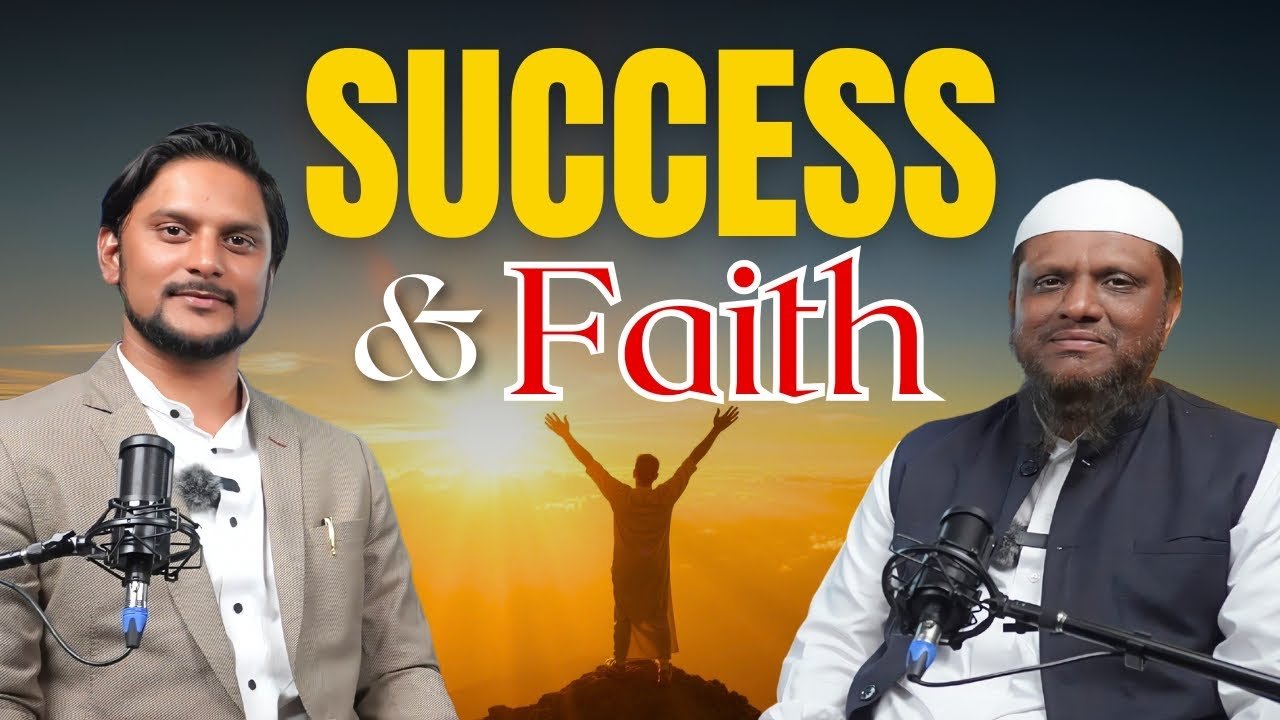
In a world where education, careers, money and professional success often dominate our priorities, it can become easy to lose sight of the purpose behind them.
But what does Islam teach us about balancing Deen and Dunya?
On this episode of The HRS Show, a powerful discussion explores this question through topics ranging from children’s education and family responsibilities to friendship, youth, social media, repentance and maintaining hope in Allah.
The conversation highlights an important principle: worldly education and professional success have value, but they should not come at the expense of our relationship with Allah and our preparation for the Hereafter.
Watch the Full Conversation
Hear the Sheikh share his advice on Deen and Dunya, family, youth, friendship, repentance and living with purpose on The HRS Show.
click the thumbnail to watch the full episode on YouTube
1. What Does It Really Mean to Balance Deen and Dunya?
One of the central themes of the conversation is the need to give both worldly life and the Hereafter their proper place.
The discussion refers to the Qur’anic supplication:
“Our Lord, give us good in this world and good in the Hereafter.”
The message is not that Muslims should abandon education, careers or worldly responsibilities.
Instead, the problem comes when worldly success becomes the entire purpose of life.
Education can help a person become a doctor, engineer, entrepreneur or professional. But knowledge should also teach a person how to live, how to treat parents, how to treat a spouse and how to fulfil their responsibilities before Allah.
The episode therefore presents a useful way of thinking about Deen and Dunya: pursue excellence in this world while remembering that the Hereafter is the ultimate destination.
2. Why Islamic Education Should Begin in Childhood
The conversation places particular emphasis on children.
Parents naturally want their children to become doctors, engineers and successful professionals. But academic education alone cannot prepare a child for every responsibility they will face later in life.
A child also needs to learn about:
- The Qur’an
- Salah
- Parents’ rights
- Family responsibilities
- The rights of a spouse
- Good character
- Responsibility before Allah
The Sheikh argues that parents should introduce children to Islamic knowledge while they are young rather than waiting until adulthood.
This does not mean abandoning modern education.
In fact, the episode gives an example of someone who combined Islamic education with an extremely successful medical career.
The larger lesson is that Deen and Dunya do not have to be enemies.
A person can pursue a demanding professional career while remaining grounded in Islamic knowledge.
3. Education Is More Than Marks and Degrees
Another important point is the difference between education and information.
A person can be highly educated academically and still lack knowledge about how to live properly.
Degrees, exam results and professional achievements can change over time.
But the way a person treats their parents, spouse, children and other people reveals another dimension of education.
The episode argues that people sometimes become extremely successful in worldly education while neglecting the knowledge needed for their responsibilities in the Hereafter.
This raises an important question for parents:
Are we preparing our children only for their careers, or are we preparing them for life?
4. Why Family Problems Can Exist Even Among Educated People
Today, more people have access to universities and professional careers than ever before.
Yet education alone has not eliminated family problems.
The conversation discusses problems involving parents, spouses and family relationships and connects many of them to a lack of knowledge about people’s rights and responsibilities.
A person may know how to build a career but not know how Islam teaches them to treat their parents.
Someone may spend months preparing for a wedding but spend very little time learning the rights and responsibilities of marriage.
The Sheikh makes a powerful point: preparing for marriage should involve more than preparing for the wedding.
It should also involve learning how to become a husband or wife.
5. Marriage Is a Responsibility, Not Ownership
One particularly important message concerns the way spouses should view one another.
The episode emphasizes that a woman entering her husband’s home is an amanah, a trust from Allah.
Marriage is not about ownership.
It is about fulfilling responsibilities and protecting the rights of another human being.
The conversation discusses the importance of knowing the rights of both spouses before marriage and learning how the Prophet ﷺ taught husbands and wives to treat one another.
This is an area where preparation can make a significant difference.
Instead of spending months preparing only for the wedding ceremony, couples can also spend time learning:
What are my responsibilities?
What are my spouse’s rights?
How should disagreements be handled?
How should we protect one another’s dignity?
These questions can help build a healthier foundation for marriage.
6. Your Friends Can Change Your Life
Another major theme of the episode is friendship.
The Sheikh reminds listeners of the well-known Islamic teaching that a person is influenced by their close companions.
A good friend can encourage you towards good.
A bad friend can gradually normalize behaviour that you would once have considered wrong.
The episode compares good company to a perfume seller: even if you don’t buy anything, you can still leave with a pleasant fragrance.
Bad company can have the opposite effect.
The lesson is simple:
Choose your friends carefully because their influence may reach you even when you don’t realize it.
7. Your Environment Matters Too
Friendship is not the only influence.
The episode also discusses the importance of the environment in which children and young people grow up.
Their:
- School
- College
- Neighborhood
- Friends
- Family environment
- Religious environment
can all influence their character.
The conversation gives examples of people whose harmful habits began through their college environment.
This is why parents should think carefully not only about where their children study, but also about what kind of environment surrounds them.
8. Why Mosques Should Welcome Young People
One of the most practical ideas in the episode is the call to make mosques more welcoming to young people.
The Sheikh argues that young people should not simply come to the mosque for Salah and immediately leave.
Mosques can become places where young people:
- Study
- Learn
- Meet good people
- Receive guidance
- Build friendships
- Develop useful skills
He even suggests using mosque spaces for academic tutoring between Asr and Isha, allowing students to receive educational support while remaining connected to the mosque.
The goal is not simply to bring young people physically into the mosque.
It is to help them build a relationship with the mosque.
9. Phones, Social Media and the Need for Self-Control
The discussion then turns to one of the biggest challenges facing today’s youth: smartphones and the internet.
The Sheikh does not argue that Muslims should simply reject technology.
Phones and the internet are now part of modern life.
The real question is:
How are we using them?
A phone combined with unrestricted internet access and complete privacy can create serious risks when there is no sense of accountability.
The answer, according to the episode, is not merely technology restrictions.
It is developing taqwa, haya and awareness that Allah sees us.
When a person knows that Allah knows what they are doing even when nobody else can see them, that awareness can act as an internal safeguard.
10. Tawbah Means Returning to Allah
One of the most hopeful sections of the conversation is about tawbah.
People make mistakes.
Some become involved in harmful habits. Others regret choices they made earlier in life.
The danger is not only the sin itself.
It is believing that you have gone too far to return.
The episode strongly rejects that hopelessness.
A person who recognizes their mistake, sincerely regrets it and turns back to Allah should never believe that the door of repentance is closed.
But the discussion also makes an important distinction.
Tawbah should not be treated as a temporary break from sin.
The intention should be to leave the sin and sincerely return to Allah.
That is very different from deciding to stop during Ramadan and planning to return to the same behaviour afterwards.
11. Never Lose Hope in Allah
The conversation then addresses people struggling with:
- Financial difficulties
- Career problems
- Marriage problems
- Family problems
- Illness
- Academic pressure
- Sin
- Addiction
- Emotional distress
The message is powerful:
A Muslim should never become hopeless in Allah’s mercy.
The Sheikh refers to the stories of Prophet Ibrahim عليه السلام and Prophet Ya’qub عليه السلام and their statements about hope in Allah.
He also discusses the example of Musa عليه السلام when the sea was in front of him and Pharaoh’s army was behind him.
From a human perspective, there appeared to be no escape.
Yet Musa عليه السلام remained confident that Allah would provide a way forward.
That is the kind of hope the episode encourages Muslims to cultivate.
Final Thoughts
This conversation on Deen and Dunya brings together many issues that Muslims face in everyday life.
It speaks about education, marriage, parenting, friendship, technology, youth, careers, stress, tawbah and hope.
But beneath all these topics is one central message:
A successful life is not measured only by what you achieve in this world.
Education matters.
Career matters.
Financial stability matters.
Family matters.
But they all need to exist within a larger purpose.
A person can pursue a career while remembering Allah.
A parent can give their children modern education while teaching them the Qur’an.
A husband and wife can build a comfortable home while remembering that marriage is an amanah.
A young person can use technology without becoming controlled by it.
And someone who has fallen into sin can return to Allah without losing hope.
That is the balance between Deen and Dunya.
The goal is not to abandon the world.
The goal is to live in this world without allowing it to make us forget the Hereafter.
Watch the Full Conversation
If these lessons resonated with you, watch the complete conversation on The HRS Show to hear the Sheikh explain these topics in his own words.
Watch the full episode on YouTube
The HRS Show also explores the importance of understanding our rights, responsibilities and education. Read our conversation with Syed Kaab Rasheedi on law, rights and the Constitution.
Subscribe to The HRS Show for more conversations on mindset, discipline, and purpose. [Watch on YouTube →]

Leave a Reply