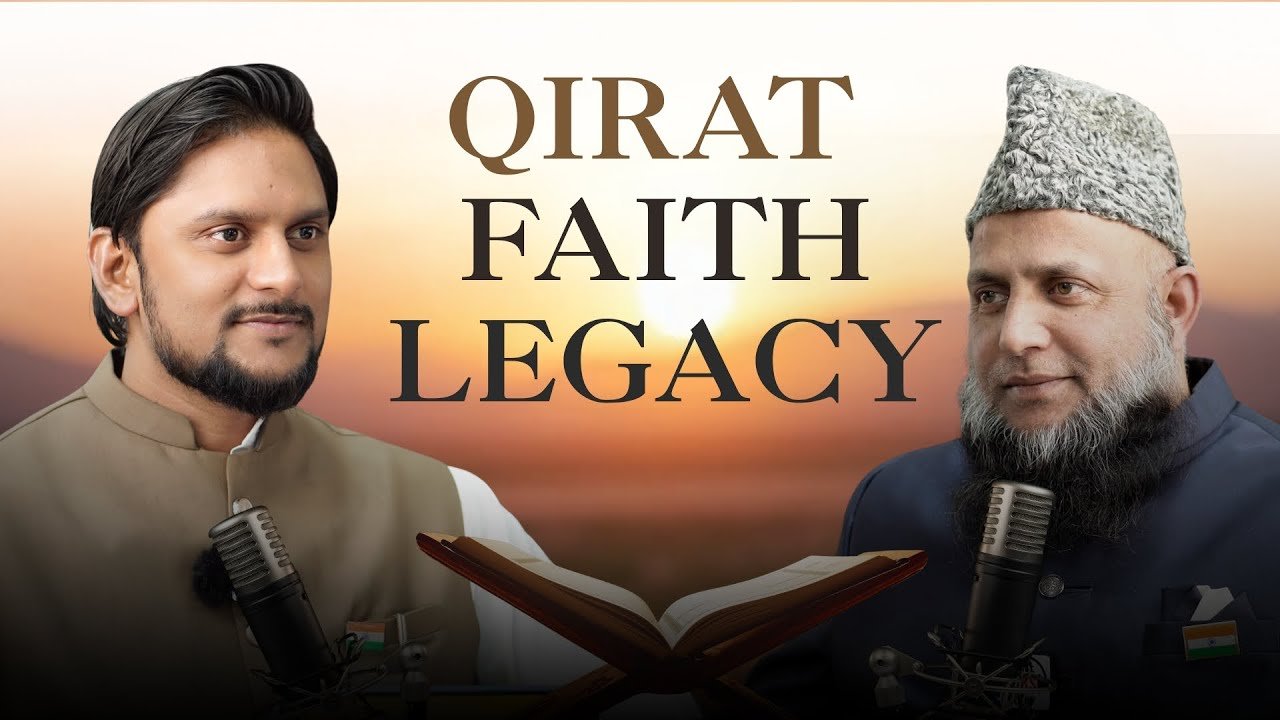
Mohammad Naseeruddin Manshawi: Quran, Qiraat & a Life of Purpose
The Qur’an can shape a person’s life in ways that go far beyond learning to recite its words. For Mohammad Naseeruddin Manshawi, the journey began in childhood and eventually took him from local Qur’an competitions to international stages in Iran, Malaysia and Egypt.
On this episode of The HRS Show, he reflects on his childhood, his passion for Qiraat, the teachers who influenced him, his connection to the legacy of Sheikh Muhammad Siddiq Al-Minshawi, and the mission behind Sharfiya Qiraat Academy.
His story is not only about achievement. It is also about family, education, discipline, language and passing something meaningful to the next generation.
Watch the Full Conversation
Hear Mohammad Naseeruddin Manshawi share his journey, experiences and reflections in his own words on The HRS Show.
Click the image below to watch the full episode on YouTube.
Watch the full episode on YouTube
1. A Childhood Shaped by the Qur’an
Manshawi’s connection with the Qur’an began at home.
He describes his parents as people who had a deep love for the Qur’an. His father, Qari Mohammad Shafuddin, was also an accomplished teacher of Tajweed and Qiraat. The Qur’an was therefore not something separate from family life. It was part of the environment in which he grew up.
His passion for Qiraat grew when he listened to the legendary Egyptian reciter Sheikh Abdul Basit Abdul Samad. As a child, he would repeatedly listen to recordings and practice the recitation himself.
That early fascination eventually became a serious commitment.
He later developed a particular admiration for Sheikh Muhammad Siddiq Al-Minshawi. His desire to study and imitate the recitation style of his inspiration became an important part of his own development.
2. From Childhood Competitions to International Stages
Manshawi’s journey did not happen overnight.
He began participating in smaller competitions while he was young. His first prize came when he was around seven years old, marking the beginning of a journey that would eventually take him onto international platforms.
In 1995, an All-India Qiraat competition was held in Hyderabad. Around 200 Huffaz and Qurra from across India participated. Manshawi was selected to represent India at the international competition in Iran.
The experience exposed him to reciters from different parts of the world.
He recalls reaching the final stage of the international competition in Tehran and finishing in fourth position. The experience also gave him something beyond a competition result: recognition from Arab participants who associated his recitation with the style of Al-Minshawi.
His international journey continued.
He later represented India in Malaysia in 1998 and travelled to Egypt in 2011.
For Manshawi, these journeys were not simply about trophies. They were opportunities to learn, meet people connected to the tradition of Qur’anic recitation and deepen his connection with the teachers and reciters who had inspired him.
3. A Special Connection to Al-Minshawi’s Legacy
One of the most memorable parts of the conversation is Manshawi’s connection with Sheikh Muhammad Siddiq Al-Minshawi.
For years, he had listened to Al-Minshawi’s recordings and worked to develop his own recitation. Eventually, he travelled to Egypt with the hope of seeing the places connected to his mentor.
That dream became reality.
During his visit, Manshawi reached the family home of Al-Minshawi and met members of his family. In 2011, he received the title “Manshawi” from Al-Minshawi’s brother at the family home. He describes the moment as a great honour.
For someone who had spent years listening to a reciter who had deeply influenced him, receiving that recognition from the family carried a meaning far greater than a competition award.
It represented the meeting of admiration, mentorship and legacy.
4. Sharfiya Qiraat Academy: Continuing a Family Mission
Manshawi’s work extends beyond his own recitation.
The foundation for his educational work was laid by his father through an institution known as Idara Shafiya. Manshawi later developed it into what is now presented as Sharfiya Qiraat Academy.
The goal is not simply to preserve an old tradition.
Manshawi explains that the academy was given a more modern identity so that younger people could connect with it more easily.
This reflects one of the central ideas of the episode: religious education and modern education do not have to be separated.
Manshawi encourages the younger generation to carry both deen and dunya together. His own life reflects that approach. Alongside his work in Qiraat, he pursued higher education and became associated with Urdu teaching at Osmania University.
5. Why Urdu Still Matters
Another important part of the conversation moves beyond Qiraat and into the preservation of Urdu.
Manshawi believes that Urdu cannot survive through conferences and seminars alone. He argues that families have an important role in keeping the language alive.
His message is simple: parents should take responsibility for teaching Urdu to their children.
He gives an example from his own teaching experience. Some children attending Qiraat classes were more comfortable writing in Roman English. However, he also encountered young students who could read and write Urdu because their mothers had taught them at home.
For Manshawi, that is evidence that preserving a language does not always require a large institution.
Sometimes, it begins with a parent sitting with a child.
6. Success Is Also About What You Pass On
Perhaps the most powerful theme of the episode is the idea of legacy.
Manshawi’s achievements include international competitions, judging national Qiraat competitions and training students. He also discusses the success of his son, Hafiz Mohammad Shoaib Shafuddin, whose Qur’an recitation journey began at a very young age.
The family environment played an important role.
Manshawi explains that children learn from what they see their parents doing. If parents regularly recite and listen to the Qur’an, children can naturally develop a relationship with it as well.
This changes the definition of success.
Success is not only about standing on a stage.
It can also mean creating an environment in which the next generation develops a love for the Qur’an.
7.The Message for Parents
Towards the end of the episode, the conversation becomes a message directly to parents.
If parents want their children to be connected to the Qur’an, they must first examine their own relationship with it.
Are we reading the Qur’an regularly?
Are we learning Tajweed?
Are we listening to good reciters?
Are we creating an environment where our children see the Qur’an as part of everyday life?
Manshawi argues that the relationship many people have with the Qur’an can become superficial. He encourages parents to strengthen their own connection first and then help the next generation develop theirs.
This is perhaps the simplest lesson from the entire conversation:
Children often follow what they see before they follow what they are told.
Final Thoughts
Mohammad Naseeruddin Manshawi’s story is much bigger than a career in Qiraat.
It is a story of a child whose love for Qur’anic recitation grew into a lifelong mission. From listening to great reciters as a young boy to representing India internationally, from receiving recognition connected to the legacy of Al-Minshawi to developing Sharfiya Qiraat Academy, his journey has remained connected to one central purpose: keeping the Qur’an, education and tradition alive for the next generation.
His message also extends beyond Qiraat.
He speaks about balancing deen and dunya, preserving Urdu, supporting young students and creating homes where children can develop a genuine connection with the Qur’an.
Ultimately, his story reminds us that a meaningful legacy is not only what we achieve ourselves.
It is what we inspire others to carry forward.
If you enjoyed this conversation, watch the full episode of The HRS Show and hear Mohammad Naseeruddin Manshawi share his journey in his own words.
Watch the full conversation on YouTube
The HRS Show explores stories of discipline, purpose and personal growth through conversations with people from different walks of life. Read our previous conversation on discipline and mission to discover another perspective on commitment and purpose.

Leave a Reply